


환경 지속가능성
환경 보호에 대한 기업의 책임을 다하고
혁신적인 친환경 제품을 지속적으로 개발하여 환경에 대한 피해를 줄이며
에너지 효율을 향상시켜자연 친화적인 환경을 보호합니다.
환경 보호에 대한 기업의 책임을 다하고
혁신적인 친환경 제품을 지속적으로 개발하여 환경에 대한 피해를 줄이며
에너지 효율을 향상시켜자연 친화적인 환경을 보호합니다.
FSP Group aligns with the Taiwanese government’s 2050 Net Zero target and the sustainability roadmap for listed companies. With the vision of becoming a global leader in green energy solutions and the mission to create value for customers, employees, and shareholders through innovative services and quality products, FSP is committed to environmental protection, customer trust, employee well-being, and social responsibility, creating long-term sustainable corporate value.
FSP Group received a CDP rating of B in 2025 and was awarded the EcoVadis Bronze Medal in 2026.
In response to the global low-carbon transition, FSP Group operates under the principles of low carbon, waste reduction, and low pollution, with a commitment to achieve net-zero emissions and 100% renewable energy use by 2050. Through continuous improvement based on the PDCA cycle, the Group enhances organizational resilience and strengthens its sustainable competitiveness.
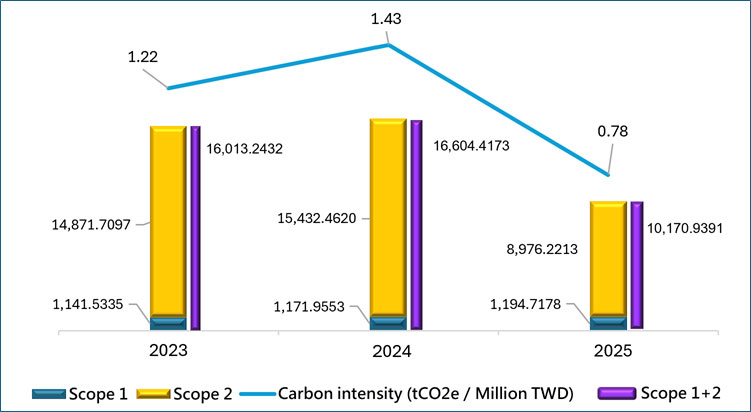
FSP Group conducts annual third-party verification of its greenhouse gas emissions in accordance with ISO 14064-1, covering all major operational sites. Compared with the 2021 baseline year, combined Scope 1 and Scope 2 emissions were reduced by 8.32% in 2024 and 43% in 2025.
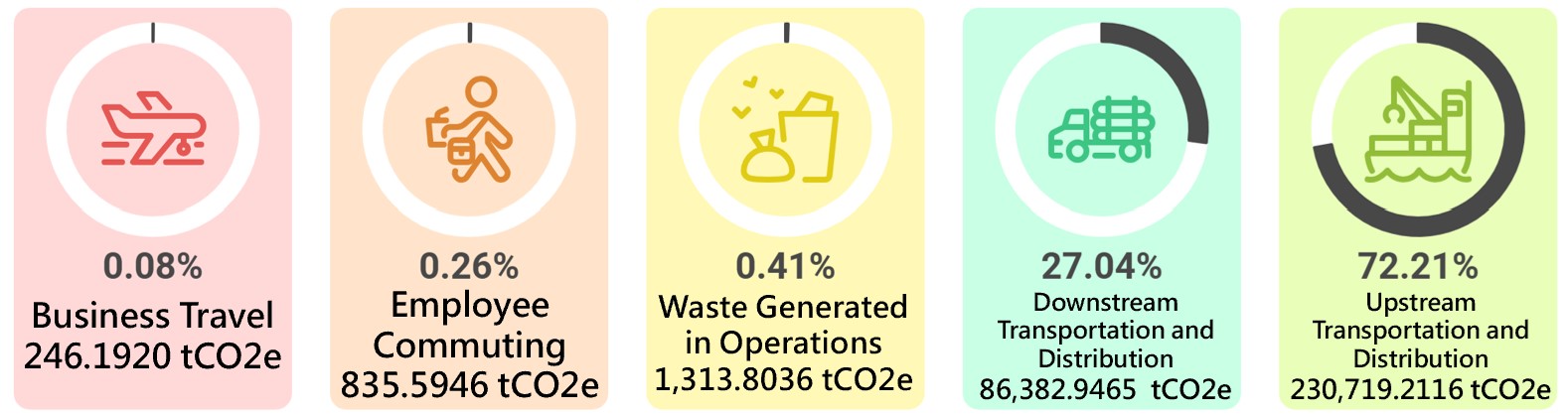
| Greenhouse gas types | CO2 | CH4 | N20 | HCFS | PFCS | SF6 | NF3 | Total emissions |
|---|---|---|---|---|---|---|---|---|
| Emissions(tCO2e) | 328,546.1340 | 967.3685 | 1.9287 | 153.2561 | 0 | 0 | 0 | 329,668.6873 |
Recent Energy-Efficient Equipment Upgrades and Results :
| Year | Site | Energy-Saving Measures and Benefits |
|---|---|---|
| 2025 | Taiwan - Taoyuan Headquarters |
Installation of an additional air compressor at headquarters
|
| China - HuaiLi Plant |
Installation of two central air-conditioning units in the PD3 and PD5 workshops
|
|
| 2024 | China - HuaiLi Plant |
Replacement of seven split-type air conditioners with a Tier-1 energy-efficient water-cooled central system in the 3rd-floor workshop of Section 8
|
Replacement of a 50 HP inverter air compressor on the 1st floor of Building C11
|
| Year | 2023 | 2024 | 2025 |
|---|---|---|---|
| China-Wuxi Plant | The renewable energy generated is 1056,157 kWh, and CO₂ emission reduced by 813.56 tons. | The renewable energy generated is 985,511 kWh, and CO₂ emission reduced by 759.14 tons. | 1.Solar power generation reached 1,159,344 kWh, resulting in a reduction of 651.20 metric tons of CO₂ emissions. 2.Total expenditure for solar power system maintenance amounted to NTD 292,856. |
| Taiwan-Taoyuan Headquarters | 1.The construction of solar panels for the Taoyuan headquarters and the third factory was completed and generated electricity. 2.Construction cost $ 10,780,125 3.The renewable energy generated is 166,405.4 kWh, and CO₂ emission reduced by 106 tons. |
1.The construction of solar panels in the second factory is completed and generates electricity. 2.Construction cost $ 4,250,000 3.The renewable energy generated is 341,607.3 kWh, and CO₂ emission reduced by 168.8 tons. |
Solar power generation reached 355,510.50 kWh, resulting in a reduction of 168.52 metric tons of CO₂ emissions. |
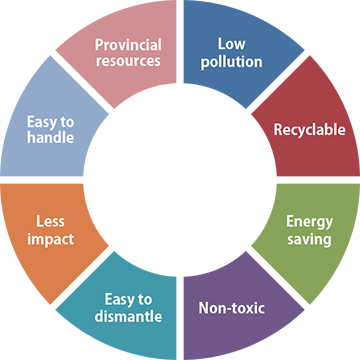
When developing new products, FSP Group has immediately considered the potential environmental impact and evaluated the product’s life cycle, from raw material selection, processing, product packaging, transportation, consumers to disposal stage, etc. FSP Group is always upholding with sustainable business philosophy and promotion of green design concept. Adhering to customer’s quality as the goal and through strict control of environmental protection projects and part recognition units, RD has designed the green products that are in line with national environmental laws and regulations around the world. The company’s green design guidelines follow:
The improvement of electricity conversion efficiency and reduction of no-load power consumption are always the goals for the company to develop high-efficiency power products. Take the products in 2012 as an example:
For PC power supply, among more than 4,600 models of 80 plus’s certified products, there are over 400 machines are qualified, which can help customer save about 10,000,000x300x10x300x 12%/1,000=1,080,000,000 KWH and reduce about 0.66 million tons of carbon emissions.
NUC power supply is a new generation of PC power supply, which can help customer save about 10,000,000x300x10x300x 12%/1,000=1,080,000,000 KWH and reduce about 0.66 million tons of carbon emissions.
TV power supply, evolved from CRT’s TV to LCD/LED TV, saving about 2,000,000x 150x 6 x300 x 15% /1,000=81,000,000 KWH and reducing about 50,000 tons of carbon emissions.
Adapter all series that in line with ErP level V products can save about 10,000,000x 60x10 x300 x 15% /1,000=270,000,000 KWH and reduce about 165,000 tons of carbon emissions.
SSL for lighting drive can save about 2,000,000x 60x 10 x300 x 85% /1,000=306,000,000 KWH and reduce about 0.18 million tons of carbon emissions.
It is roughly estimated that FSP Group’s power supply products on the market can save customers about 1.737 billion KWH or reduce about 1.055 million tons of carbon emissions, which is contributing to the environmental protection.
The exploitation of rare metals like cassiterite, black tungsten, coltan and gold in the Democratic Republic of the Congo and its surrounding countries has caused serious human right and environmental problems, which is known by the media as conflict minerals.
Although FSP Group has no the demand to directly purchase the minerals, based on corporate’s social responsibility and environmental protection practice, in order to avoid using illegal mining metals in raw materials and the production process, we express our concerns on the issue of conflict minerals to the suppliers and make a statement of no using conflict minerals to the suppliers. Through the conflict mineral reporting template between RMI and CMRT, we investigate relevant suppliers and require them to ensure that the use of raw materials will not lead to conflict minerals disputes.
Policy of FSP Group prohibits the use of conflict minerals:
Do not support and do not use the conflict mineral metals mined from armed conflict, illegal and poor environments in order to fulfill enterprise’s social responsibility. And ask suppliers to investigate whether their products contain gold (Au), tantalum (Ta), tin (Sn), tungsten (W), cobalt (Co) and other metals and to confirm the source of these minerals.
The company’s conflict minerals policy will be publicized in the website of FSP Group and will be advocated regularly at the supplier meeting.